A 10-card spread
Celtic Cross tarot spread
Celtic Cross tarot spread: the meaning of each position and the reading order. The best-known spread for a big question: ten cards show how the situation took shape, what holds it in place and where it may be heading.
- 10 cards
- 150 crystals
- the free first spread doesn’t apply to this one
What this spread is
People lay out the Celtic Cross when one or three cards are not enough: a hard decision, a turning point, a situation where feelings, circumstances and other people are tangled together. Six cards form the cross: the situation itself with its challenge, its past and its near future. The four cards in the column on the right, the “staff,” show where you stand, your surroundings, your hopes and fears, and the outcome.
Arthur Waite described this spread in a 1910 book and presented it as an ancient “Celtic” method, but there is no evidence that it is that old. So treat it as a useful framework for a conversation with the cards, not as a time-honored ritual. Read it in stages: the cross first, then the staff, and finally all ten cards together as one story.
What each position means
- Present. The heart of the question: what is happening now and what you are asking about. This card sets the tone for the whole spread.
- Challenge. What crosses the situation: a doubt, a circumstance, a habit. The card is not necessarily “bad”: sometimes the challenge simply asks for attention.
- Conscious goal. What you are reaching for and how you see it. This is the card above the cross: what is right in front of your eyes.
- Root. What lies beneath the surface: old beliefs, motives you haven’t noticed, the background against which you make decisions.
- Recent past. What has passed but still echoes: the events and decisions that led to this moment.
- Near future. What will open up soon if nothing changes. It is a direction, not a verdict.
- Yourself. How you act in this situation and what you feel in it: your role, your state, your stance.
- Environment. The circumstances and people around you and their influence on the situation. The card describes the circumstances, not what someone thinks or plans.
- Hopes and fears. What you hope for and what you fear, often at the same time. One card for both feelings suggests where they meet.
- Outcome. Where the situation may lead if you keep moving the same way. Read it together with the seventh card, “Yourself”: it shows what is in your power to change course.
Which questions it suits
- I have to make an important decision and I can’t see the whole picture.
- What brought me to this situation, and what depends on me in it?
- I’m at a crossroads in my work or my life: what should I consider?
- Why does the same theme keep coming back to me?
- How can I prepare for the changes that have already begun?
What this spread won’t show
The Celtic Cross doesn’t give a yes-or-no answer (for that there is the “Yes or no” spread) and doesn’t tell you what other people think or have planned: the cards show the situation from your side. It doesn’t replace a conversation with the people close to you or, on questions of health or law, a professional. Don’t expect amounts of money, dates or a guaranteed outcome from it either.
A short example
Question: I’m hesitating about starting something I’ve dreamed of for a long time. What should I keep in mind?
- Present: Two of Wands, you stand with a whole world in your hands, choosing a direction.
- Challenge: Four of Pentacles, the wish to hold on to what is safe and familiar.
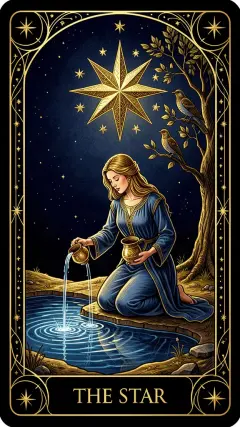
- Conscious goal: The Star, you want light and hope.
- Root: The Moon, anxiety about the unknown, fog on the road.
- Recent past: Eight of Pentacles, years of patient learning.
- Near future: Ace of Wands, a push and a new idea.
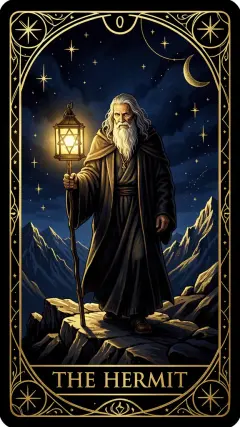
- Yourself: The Hermit, you think everything over in silence.
- Environment: Three of Cups, the support of friends and loved ones.
- Hopes and fears: Seven of Cups, many dreams, and the real ones have to be told apart from the rest.
- Outcome: Strength, calm inner confidence.
Putting it together: behind you is a skill built through patient practice, ahead is a choice of direction, and what holds you back is the wish to keep your familiar sense of security. The Ace of Wands in the near future sounds like an invitation to start small, and Strength in the outcome reminds you that calm confidence helps more than a sudden leap.
The example is made up: it shows how the positions are read, not what will “come up” for you.
How to read the spread
- Reading order: first cards 1 and 2 (the heart of the matter and the challenge), then the “past and future” axis (5 and 6), then the conscious goal and the root (3 and 4), and finally the staff from the bottom up (7–10).
- Count the Major Arcana: many of them mean the theme is significant and “big,” while the Minor Arcana describe everyday matters.
- If cards 3 and 9 contradict each other, the spread hasn’t gone wrong. This is what inner conflict looks like, and it is exactly what is worth talking over with yourself.
- Read a reversed card as a weakened, blocked or inward side of the theme, not as a “bad” card.
- The outcome is not a verdict: reread the seventh card and ask yourself what changes if you act differently.
Who lays out the cards in the bot
In the bot, the spread is laid out by Iris, an artificial intelligence rather than a human tarot reader. We don’t hide it. She interprets exactly the cards that came up, in light of your question and the positions of this spread. It is entertainment and a reason to reflect, not a forecast or advice on health, money or legal matters.
See also
Frequently asked questions
How many cards are in the Celtic Cross?
Ten: six form the cross (the situation, the challenge, the conscious goal, the root, the recent past, the near future) and four make up the staff on the right (you, your environment, hopes and fears, the outcome).
How often can I do the Celtic Cross?
It is best to do it only when the situation has really changed. Redrawing cards until a pleasant one comes up means you are reading a wish, not a spread. For daily practice there is the card of the day.
How is it different from a three-card spread?
Three cards give a “past, present, future” line. The cross adds the challenge, the subconscious background, the surroundings and the pair “hopes and fears,” so it suits complex questions.
Will the spread show what another person thinks?
No. The cards help you look at the situation from your side: what you feel, what surrounds you, what depends on you. They don’t reveal other people’s thoughts or intentions.
How much does the Celtic Cross cost in the bot?
150 crystals. One crystal equals one Telegram Star. The free first spread doesn’t apply to the Celtic Cross.
Who does the reading?
Iris, an AI tarot reader. She interprets the cards that came up for you, and you decide what to do with it.